What is the Amsler Grid?
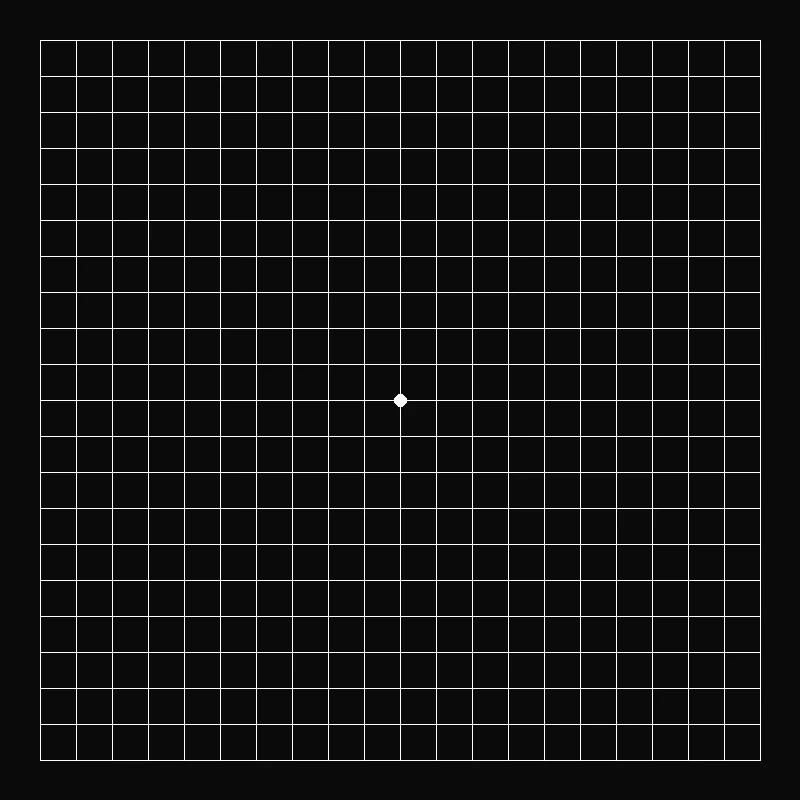
The Amsler grid is a simple diagnostic tool developed by Swiss ophthalmologist Marc Amsler in 1947. It consists of a square grid pattern with evenly spaced horizontal and vertical lines and a prominent dot in the center. Despite its simple design, this test method has proven over decades to be one of the most important instruments for detecting changes in the macula – that small but crucial area of the retina responsible for sharp, central vision.
The basic principle of the test is remarkably simple: if the macula is healthy, all lines of the grid appear straight and uniform. However, if areas of the retina are damaged or altered – for example, by deposits, fluid accumulation, or the loss of photoreceptors – the lines in the affected areas are perceived as wavy, distorted, or broken. These distortions, known in medical terminology as metamorphopsia, can be an early sign of age-related macular degeneration (AMD) or other retinal diseases.
Ophthalmologists worldwide recommend the Amsler grid test as a supplementary monitoring tool for patients with known AMD or an increased risk for the condition. The German Professional Association of Ophthalmologists (BVA) also emphasizes its importance for self-monitoring between regular check-ups.
Why is the self-check so important for AMD?
Age-related macular degeneration often progresses insidiously. In the early stages of dry AMD, changes can occur without the affected person noticing any significant symptoms. The brain is a master at compensating for minor visual deficits, especially if only one eye is affected. The healthy eye takes over, and the visual impairment goes unnoticed in everyday life.
This is precisely where the danger lies. The transition from the more common dry AMD to the aggressive wet AMD can happen suddenly. In wet AMD, abnormal blood vessels grow under the retina, leaking fluid and blood. This can lead to rapid and severe vision loss within a few weeks or months. The earlier this transition is detected, the better the chances of preserving vision through treatments like anti-VEGF injections.
The daily check with the Amsler grid helps to detect even subtle changes, such as the first appearance of wavy lines, long before they become noticeable in daily life. It is a simple, free, and highly effective early warning system that you can use at home.
Step-by-Step Guide to the Amsler Grid Test
Performing the test is simple and takes less than a minute per eye. Follow these steps to ensure reliable results:
- Wear your usual reading glasses or contact lenses.
- Hold the Amsler grid at a comfortable reading distance (approx. 30-40 cm) in good, uniform lighting.
- Cover one eye with your hand.
- Focus on the central dot with your open eye. Keep your gaze fixed on this point throughout the test.
- While looking at the dot, pay attention to the surrounding grid. Are all lines straight and parallel? Are all squares of the same size? Are there any missing or blurry areas?
- Repeat the test for the other eye.
It is crucial to test each eye separately. Only then can you identify changes that might otherwise be compensated for by the other eye.
Interpreting Warning Signs Correctly
A normal finding is when you see the central dot clearly and all lines of the grid appear straight and uninterrupted. The following changes may indicate a problem with the macula and should be clarified by an ophthalmologist immediately:
- Wavy or bent lines (Metamorphopsia)
- Distorted or incorrectly sized squares
- Blurry or hazy spots (Scotoma)
- Missing areas or dark spots in the grid
If you notice one or more of these changes for the first time, or if existing distortions worsen, do not hesitate to contact your ophthalmologist immediately. This is considered an emergency, especially if the changes occur suddenly.
Limitations of the Amsler Grid Test
Despite its high value, the Amsler grid test also has its limitations. It is important to be aware of them:
- Not a substitute for an eye exam: The test cannot replace a comprehensive examination by an ophthalmologist, which includes measuring visual acuity, examining the fundus, and possibly performing an OCT (Optical Coherence Tomography).
- Limited sensitivity: The test may not detect very small or very peripheral changes. A normal Amsler grid result does not completely rule out a retinal disease.
- Dependent on patient cooperation: The reliability of the test depends on how carefully it is performed and how well the patient can describe their observations.
Therefore, the Amsler grid test should always be seen as a complementary tool for self-monitoring between regular professional check-ups.
When should you see an ophthalmologist?
Regular check-ups are essential for AMD patients. Additionally, you should see your ophthalmologist immediately if you notice any of the following:
- New or worsening distortions in the Amsler grid.
- A sudden deterioration in your central vision.
- A dark or blurry spot that appears in your central field of vision.
- Difficulty reading or recognizing faces, even with good lighting.
Early action is crucial. The sooner treatment for wet AMD is initiated, the greater the chance of stabilizing or even improving vision.
Early Detection and Treatment: What are the options?
If early-stage AMD is detected, there are several ways to positively influence the course of the disease. In addition to lifestyle adjustments such as a balanced diet, quitting smoking, and UV protection, specific nutritional supplements (AREDS2 formulation) can slow the progression in certain stages of dry AMD.
For advanced dry AMD with geographic atrophy and for wet AMD, new therapeutic approaches are constantly being researched. One promising method is Photobiomodulation (PBM). This involves treating the retina with low-energy light of specific wavelengths to stimulate cellular metabolism, reduce inflammation, and slow down cell death.
Initial studies have shown that PBM can lead to an improvement in visual acuity and contrast sensitivity in patients with intermediate dry AMD.
In Germany, Photobiomodulation is currently being scientifically investigated as part of the nationwide MACULIGHT study. For the first time, the effectiveness of PBM in home use is being researched – an approach that could allow patients to receive regular treatment in their own homes without being dependent on frequent visits to the practice.
Learn more about Photobiomodulation as an innovative therapeutic approach for dry AMD and the current state of research.
Learn more about PhotobiomodulationThe combination of regular self-monitoring with the Amsler grid, professional ophthalmological care, and constantly evolving treatment options gives AMD patients more agency than ever before. The first step begins with paying attention to one's own vision – and this is exactly where the Amsler grid self-check comes in.
Conclusion: Consistency is Key
The Amsler grid test is not a high-tech procedure and does not claim to replace an ophthalmological examination. Its strength lies in its simplicity and daily availability. Less than a minute per eye is enough to detect changes in central vision that are easily overlooked in everyday life. Especially with a disease like AMD, where the transition from the dry to the wet form can happen quickly and without warning, this daily attention is invaluable.
Make the Amsler grid test a fixed part of your daily routine – for example, in the morning after getting up or in the evening before going to bed. Test each eye individually, note your observations, and do not hesitate to contact your ophthalmologist if you notice any changes. Early detection is the most important factor in preserving vision in AMD, and the Amsler grid self-check is one of the simplest tools available to you for this purpose.
Talk to your ophthalmologist about the optimal combination of self-monitoring, regular check-ups, and, if necessary, supplementary therapeutic approaches. Together, you can develop an individual strategy that provides the best possible support for your vision.
Sources and Further Information
- Amsler M. L'examen qualitatif de la fonction maculaire. Ophthalmologica. 1947;114(4–5):248–261.
- American Academy of Ophthalmology. All About the Amsler Grid and Daily Vision Checks for AMD. December 2025. aao.org
- German Federation of the Blind and Partially Sighted (DBSV). Amsler Grid Test. dbsv.org
- BrightFocus Foundation. Amsler Grid Eye Test. February 2024. brightfocus.org
- Apotheken Umschau. Age-Related Macular Degeneration (AMD) – Early Detection. February 2023. apotheken-umschau.de
- Ratgeber Makula. The Amsler Grid Test. ratgeber-makula.de